


Is USB 4 really the latest version of USB?
Release time:
2019-07-20
The newly released USB 4 connector specification is mainly used for high-speed data transmission in automated systems. However, USB 3.2 products will first appear in the market.

USB 3.2 connectors will start appearing in various devices in the coming months. The latest USB standard announced at the end of 2017 has not yet made its debut, and suddenly, USB 3.2 is no longer the latest USB standard. USB 4 has emerged. In March 2019, the USB Promoter Group announced that the USB 4 specification would be released in mid-2019. However, we will need at least another year to see it appear in devices. Before that, USB 3.2 will be the latest version available.
USB 3.2 is actually a collective term for several different specifications. USB 3.2 Gen 1 (or SuperSpeed USB); the previous version USB 3.0, which has a speed of 5GB/s; USB 3.2 Gen 2 (or SuperSpeed USB 10 Gb/s) can reach a single-channel speed of 10 Gb/s. The latest version of USB 3.2 (SuperSpeed USB 20 Gb/s) has two 10 Gb/s channels, with a maximum speed of 20 Gb/s. It is also known as USB 3.2 Gen 2×2. USB 3.2 Gen 2×2 uses a Type-C connector.
The various USB protocols and their respective performance levels, names, and technical specifications provided for developers are as follows:
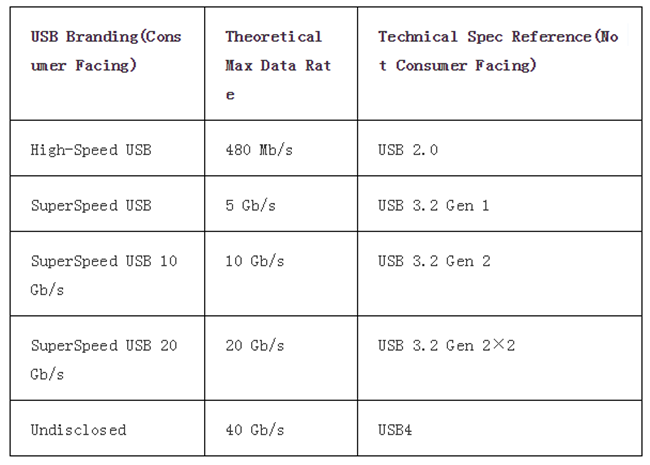
To ensure compatibility between devices and achieve the expected speed and performance, it is crucial to communicate the USB 3.2 specification used by the devices. Additionally, to support specific USB standards, appropriate ports and cables must be specified; otherwise, the connectors can only support lower bandwidth.
It should be noted that the USB Promoter Group, including Apple, Intel, Renesas, ST MicroElectronics, HP, Microsoft, and Texas Instruments, has established a 40Gb/s USB specification, and USB 4 will be able to support data transmission and host-based algorithms, making it a high-performance connector for devices connected to the Internet of Things and Industry 4.0. Like USB 3.2, it will use a Type-C connector and come with high-speed cables while being compatible with all previous USB versions.
Another feature of USB 4 is the inclusion of Intel's Thunderbolt 3 standard, which will allow USB-connected devices to communicate with each other without the need for a hub. This makes USB 4 a way to connect multiple high-speed devices together, enabling them to share data quickly. We will see such hardware on the market by the end of 2020 or early 2021. At the same time, this makes USB 3.2 a popular new USB connector, but it is estimated that this time will not last long.

Mr. Jeff Ravencraft (President and COO of USB-IF organization)
To this end, we spoke with Jeff Ravencraft, the President and COO of the USB-IF Association, to learn about the latest two USB connectors.
With USB 3.2 still being promoted, should designers bypass this specification and switch to USB 4?
The decision on which USB specification to implement entirely depends on the manufacturer and the features required by the product being developed. That is to say, the USB 4 specification will be compatible with USB 3.2 and USB 2.0, etc., so manufacturers developing products based on these existing USB protocols can know whether their solutions will comply with future USB specifications. Compatibility is one of the important factors in promoting USB products.
Under what circumstances might they choose USB 3.2 instead of USB 4?
In cases where 40 Gb/s speed is not required, multiple data transfers are sufficient to meet the requirements, and compatibility with ThunderBolt 3.0 is not needed, developers may choose USB 3.2 instead of USB 4. For example, applications for mobile phones and tablets.
What impact will the older USB specifications that are still in use have?
USB 3.2 and USB 2.0 will continue to be widely used specifications available for developers to design products as needed. As mentioned above, the USB 4 specification is compatible with USB 2.0 and USB 3.2.
What impact does this have on the Internet of Things or artificial intelligence?
The higher data transmission performance provided by the USB 4 specification will continue to improve Internet of Things devices and artificial intelligence/machine learning applications, as both of these technological fields benefit from the development of connectors that can transmit and receive increasingly large amounts of data, video, and graphics at extremely fast speeds.
Will USB 4 have standard markings on the casing, or will there be new designs?
The release of USB 4 is part of the USB performance roadmap, currently specifically targeting developers. Branding and marketing guidelines will be established after the final specifications are announced. That is to say, the implementation of USB 4 will require USB Type-C cables and connectors. The USB Type-C specification can be downloaded from the USB-IF document library.
What does it mean to use cables with USB 4?
Although the USB 4 specification is still in draft form, it will not specifically define cable lengths but will specify cable performance requirements. Cable manufacturers will strive to produce the longest cables to demonstrate their ability to manufacture cables that meet various requirements.
What else should designers know about the performance or architecture of this new specification?
To fully utilize the advantages of USB 4 at 40 Gb/s, users will need USB Type-C cables that are certified for 40 Gb/s. Existing certified 10 Gb/s and 20 Gb/s cables will support 10 Gb/s and 20 Gb/s USB 4, respectively. In addition, USB 4 also defines a new USB architecture for simultaneously transmitting multiple independent traditional data streams and aggregating them onto the USB 4 bus. The new protocol allows USB 4 host systems to optimally balance bus bandwidth between these data streams, best matching the performance of each connected device, such as storage, networking, etc.
Which connector companies participated in the development process of USB 4?
The USB 4 specification is a protocol specification and is therefore separate from the USB Type-C specification that defines USB Type-C cables and connectors. That is to say, the implementation of USB 4 requires USB Type-C, and multiple connector companies actively participating in the development of the USB 4 specification are necessary to complete it. A detailed list of contributing companies will be published after the USB 4 specification document is finalized. USB-IF is an advocate of open standards, and like all USB specifications, once the USB 4 specification is released, it will be made available to everyone worldwide.
Related News
2025-12-31
2025-07-28
NO.7, Chuangyuan Rd, Jiaozhou Bay Comprehensive Bonded Zone, Hetao Sub-district, Chengyang District, Qingdao, Shandong Province, P.R.C.