


Chinese scientists have achieved low-cost preparation of deuterated acids and bases, which is expected to be applied in luminescent materials such as OLEDs.
Release time:
2025-07-21
According to the Chinese Academy of Sciences, recently, Professor Xu Tongwen, Professor Wang Yaoming, and Professor Li Zhenyu's team from the National Key Laboratory of Precision Intelligent Chemistry at the University of Science and Technology of China have made breakthrough progress in the preparation of deuterated chemicals. The team innovatively utilized bipolar membranes to achieve efficient dissociation of heavy water (D2O), revealing for the first time the phenomenon where the migration rate of deuterium ions (D+) surpasses that of hydrogen ions (H+) due to nuclear quantum effects, overturning the traditional understanding that "the dissociation rate of heavy water is slow," and developed a new technology for the low-cost and high-efficiency preparation of deuterated acids and deuterated bases.
Deuterated acids and deuterated bases are key raw materials for synthesizing deuterated drugs and conducting hydrogen/deuterium (H/D) exchange reactions, with significant application prospects in luminescent materials such as OLEDs. Currently, the production of deuterated acids and bases generally faces issues such as complex and diverse processes, harsh reaction conditions, difficulties in product purification, and high energy consumption for concentration.
This research uses inexpensive heavy water and inorganic salts as raw materials, directly and efficiently dissociating heavy water at room temperature using bipolar membrane electrodialysis technology, generating high concentrations of deuterated acids and deuterated bases in one step, significantly reducing production costs, and is expected to provide economical and high-quality raw materials for numerous downstream deuterated chemicals.
The study elucidated the core mechanism of efficient dissociation of heavy water using bipolar membranes. Under the influence of reverse bias, ions in the intermediate layer of the bipolar membrane are oriented and migrate out, with the dissociated deuterium ions and deuteroxide ions becoming the sources of deuterated acids and bases. The research found that the higher deuterium-oxygen bond energy and lower ion diffusion coefficient in the heavy water system jointly lead to a significant increase in the voltage of the bipolar membrane electrodialysis stack. At the same time, the higher limiting current density of the bipolar membrane and the solution resistance make the time required for heavy water dissociation to reach a steady state much longer than that of ordinary water dissociation. Analysis shows that the dissociation resistance of the intermediate layer of the bipolar membrane, the mass transfer resistance of the membrane layer, and the diffusion boundary layer resistance in the heavy water system are all significantly higher than those in the water system. Under the same amount of charge consumption, the generation rate of deuterium ions/deuteroxide ions is actually 1.25 times that of hydrogen ions/hydroxide ions, which overturns the inherent understanding of the acid-base production rate of heavy water. Molecular dynamics simulations found that the higher viscosity and stronger hydrogen bond network of heavy water increase the migration resistance of cations such as potassium ions, making their solvation shell more stable and ordered; there are differences in the migration capabilities of deuterium ions and protons within the membrane phase. First-principles calculations confirmed that the clusters of deuterium ions in the membrane phase have a lower dehydration energy barrier than proton clusters, leading to a nearly 7-fold difference in their migration rates. This indicates that the rapid and ordered diffusion of ions within the membrane phase enhances the dissociation efficiency of the intermediate layer of the bipolar membrane.
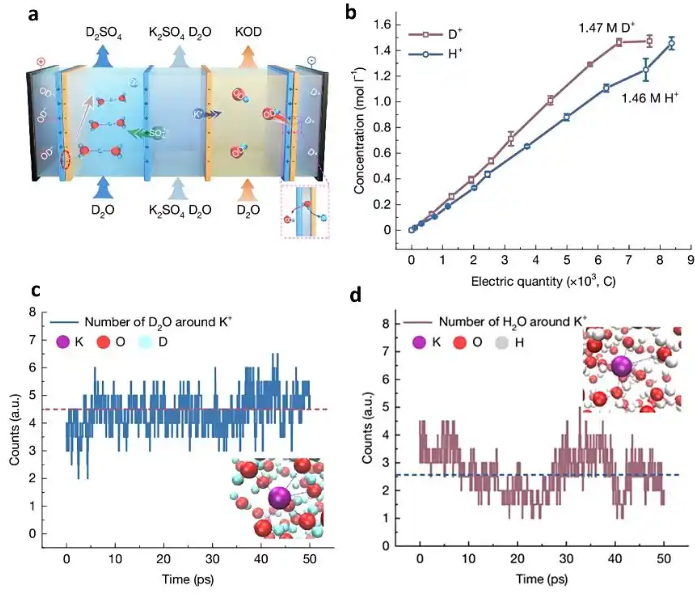
▲ Schematic diagram and theoretical simulation of bipolar membrane heavy water dissociation
Based on the above principles, the researchers expanded the new technology to multiple systems, achieving efficient preparation of a series of deuterated acids and deuterated bases such as deuterated sulfuric acid, deuterated hydrochloric acid, deuterated fluoride, deuterated nitric acid, deuterated potassium oxide, and deuterated sodium oxide. The deuterated acid and base preparation platform, centered on the bipolar membrane heavy water dissociation technology, has an average production cost of only about 20% of traditional processes. The entire production process does not require the use of highly corrosive reagents or heavy metal catalysts, with emissions approaching zero, highlighting its environmentally friendly characteristics. Currently, this technology has completed engineering scale-up, with a capacity of producing 3 tons of deuterated acids and bases annually, laying the foundation for its industrial large-scale production.
On July 9, the relevant research results were published online in "Nature" under the title "Synthesis of deuterated acids and bases using bipolar membranes." The research work was supported by the National Key Research and Development Program, the National Natural Science Foundation, and the Chinese Academy of Sciences' Basic and Cross-Frontier Scientific Research Pilot Special Project.
Related News
2025-12-31
2025-07-28
NO.7, Chuangyuan Rd, Jiaozhou Bay Comprehensive Bonded Zone, Hetao Sub-district, Chengyang District, Qingdao, Shandong Province, P.R.C.