


5G networks require higher standards for cables and connectors.
Release time:
2019-07-20
The new generation of fiber optic cables and high-speed connection products is laying a solid foundation for the comprehensive implementation of 5G networks.
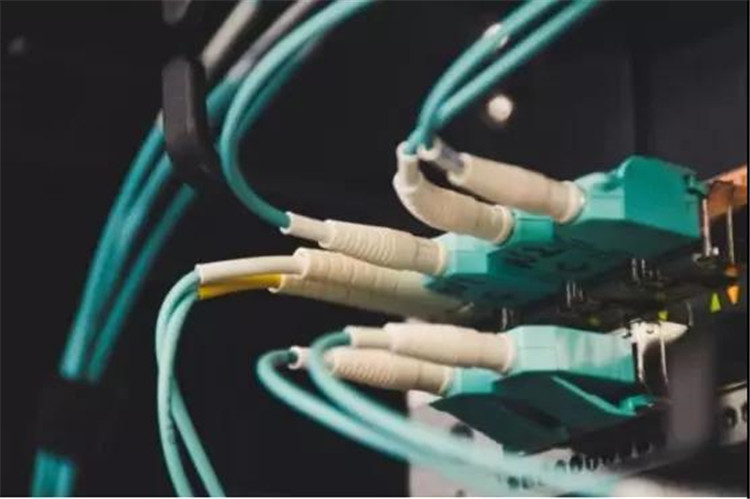
Suppliers of fiber optic cables, high-speed connectors, and cable management systems are preparing to meet the challenges brought by the full deployment of 5G network infrastructure. The arrival of 5G networks has a significant impact on these key components, especially the connectors and cables used in wireless and wired infrastructure. Recently, the United States and the United Kingdom announced the acceleration of 5G network development, injecting vitality into the entire network industry. Today, Western economies are trying to compete with the 5G technology launched by China.
The call for the comprehensive promotion of 5G at this year's Optical Fiber Communication Exhibition (OFC) is getting louder. "The arrival of 5G networks will change everything, including autonomous driving, real-time vehicle-to-vehicle (V2V) communication, and even remote-assisted surgery," said Gilles Garcia, head of communications business at Xilinx. He is a leader in FPGA and high-speed network technology development, and he also pointed out, "Moving from 10G to 400G will be a challenge." Members of the Ethernet Alliance, including Amphenol, Cisco, Xilinx, and Juniper, jointly showcased the application of 400G links at OFC 2019, which was held from March 3 to 7, 2019, in San Diego, California.
However, the large-scale realization of this leap will depend on the adoption of new cable technologies. Around the world, copper-based mobile backhaul architectures are being upgraded to packet transmission architectures via fiber optics. Fiber optic cables can transmit higher bandwidth, making them an essential configuration for the processing speed of future 5G network products. Small base stations that match 5G networks, new devices, and products must all be able to handle higher speeds and densities while reducing latency, consuming less energy, and generating less heat. To support these new market demands, a range of new connection products will make this transition easier.
Novel and advanced cable deployment and management
In recent years, significant progress has been made in cable deployment and management. Many new applications save time for installation and troubleshooting. For example, Amphenol's traceable patch cable assembly system allows installers to track the fiber optic cable by embedding a light source.
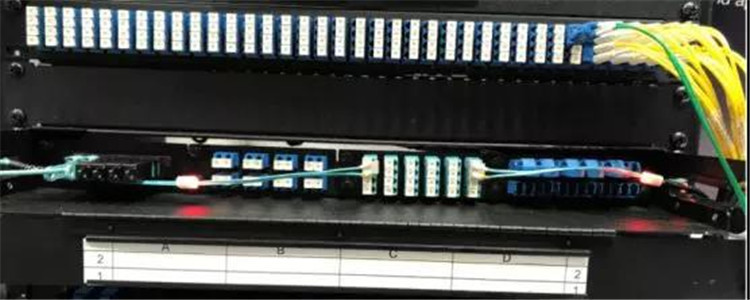
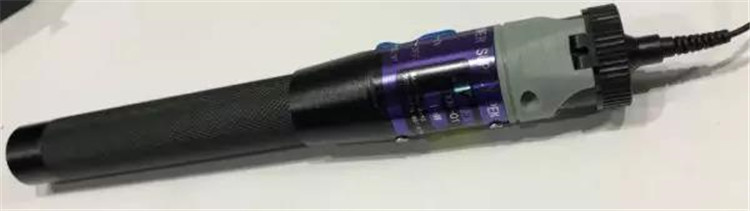
Amphenol's traceable patch cable light source solution
Traceable patch cables make it easier to track the far end of fiber optic patch cables and are particularly useful in IT/Datacom high-speed links and data centers, where many servers or network setups are interconnected by dense cabling. Red LEDs are installed at both ends of the cable jumpers, especially when there are many cross-connections. These TIA/EIA and IEC standard components can support 400 Gb/s, supporting both single-mode bend-insensitive fiber (≤0.15dB) and multimode OM3 and OM4 fibers (≤0.50dB), with an operating range from -40°C to 85°C and an operational range <0.3dB. Equipped with UPC connectors, the return loss at 500 working cycles (<0.2dB) is ≤-55dB. Molex offers similar solutions, where fiber links will help installers find and identify cables through flashing green light.
Small high-speed cables
To squeeze more fiber optic cables into increasingly smaller spaces, cable manufacturers are working to reduce the size and diameter of cable bundles. For example, Corning is shrinking the size of 400 Gb/s cables. The Corning SMF-28 ultra-high 200 fiber optic cable features a coating thickness of only 200 microns, down from the previous product's 245 microns, while maintaining a glass cladding diameter of 125 microns in single-mode fiber.
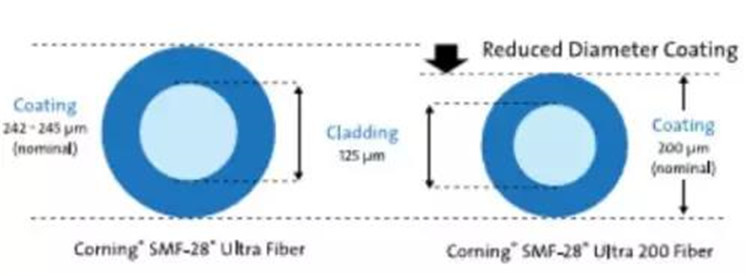
Corning SMF-28 ultra-small fiber optic cable
These cables also comply with ITU-T G.652.D and ITU-T G.657.A1 standards, although these standards require a 10-micron radius bend, Corning cables allow bending with a 33-micron radius, providing a significant improvement of 30%.
As high-speed network infrastructure continues to evolve, with increasing processing speeds forming the foundation of 5G networks, fiber optic solutions like these will replace copper cables in transatlantic submarine transmission pipelines. Corning's TXF fiber optic cable is made from low-loss, silicon core fiber optic material, which has a large effective area capable of transmitting high-speed data over long periods. With two 200-kilometer submarine backhaul links capable of supporting 400 Tb/s, these ITU-T G.654 compliant fiber optic solutions have the potential to become the large-scale cable solutions needed for the global rollout of 5G network technology.
Similarly, the Prysmian Group, headquartered in Italy, recently added a new product to its FlexRibbon series, with a density of 6,912 fibers and a maximum length of 9,843 feet (1.86 miles or 3 kilometers). The two-inch conduit contains 6,912 bend-insensitive fiber optics. The cable consists of 24 bundles, each containing 288 fibers, making it easy to manage. Additionally, the cable's outer diameter (OD) is only 1.54 inches, and the remaining space in the 2-inch conduit can support future expansion needs.
More powerful interconnections
5G network transmission, whether for data centers, small base stations, or other applications, requires better connectors. Samtec's NovaRay connector can provide a transmission of 112 Gb/s per channel in PAM 4 mode. To achieve a total data rate of 4.0 Tb/s, differential pairs must be fully shielded to minimize crosstalk (up to 40 GHz). By using BGA instead of traditional chips to increase density, these cable components can have 8 to 32 pairs of signal pairs, with the next generation including 72 pairs. This design also reduces board edge space by 40% compared to previous versions. At a recent trade show, Samtec also showcased a 56 Gb/s (PAM 4) cable component with a diameter of 7.6 mm. To achieve 400 G, developers typically combine 4x100Gb/s or 8x50Gb/s. The 34 AWG low-skew (<3.5ps/m) cable in Samtec's solution enhances bandwidth (28-112 GB/s), configured for 8 pairs and 16 pairs, with plans for the next generation to include 24 pairs.
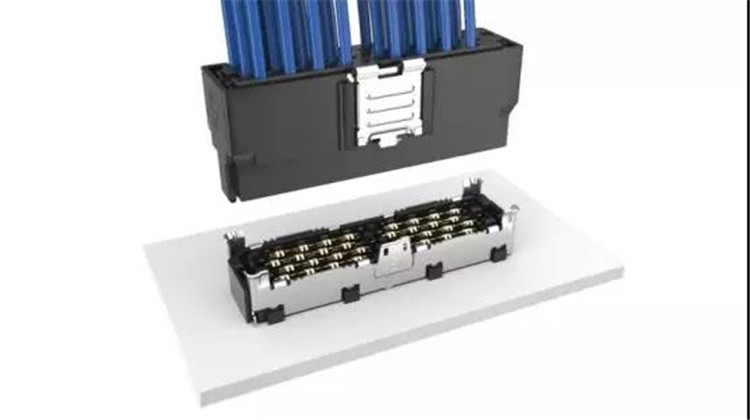
Samtec's NovaRay connection solution
Samtec's ExaMAX high-speed backplane system supports 56 Gb/s, with a 2.00 mm pitch, compatible with PCI Express, Intel OPI and UPI, SAS, SATA, Fibre Channel, Infiniband, and Ethernet protocols, and complies with OIF CEI-28G-LR (28 GB/s) standards. The rated current for each signal contact is 0.5A, with an operating temperature range from -55°C to 85°C.
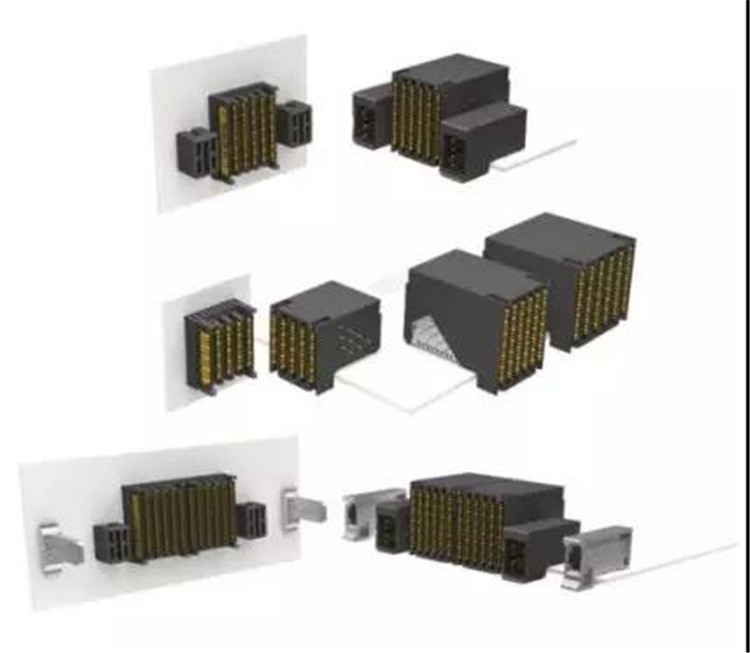
Samtec's 2mm pitch ExaMAX connector
The new generation of cable and connector suppliers is actively preparing for the arrival of 5G networks. The large-scale launch of new connectors and cable products is expected to begin in 2020.
Previous page
Related News
2025-12-31
2025-07-28
NO.7, Chuangyuan Rd, Jiaozhou Bay Comprehensive Bonded Zone, Hetao Sub-district, Chengyang District, Qingdao, Shandong Province, P.R.C.